

Key Takeaways
- Both keratoconus and astigmatism affect the shape of your cornea, but they are different conditions.
- Astigmatism is common and manageable with glasses, contacts, or surgery.
- Keratoconus is progressive and needs early detection to preserve vision.
- Corneal mapping and a thorough eye exam can tell them apart when symptoms look the same.
- Seeing an ophthalmologist in Calgary early gives you more treatment options.
Two Conditions, One Cornea
You squint at a screen, struggle to read a menu across the room, or notice lights leaving strange streaks at night. It’s easy to chalk it up to needing a new glasses prescription. Sometimes, however, what’s happening on the surface of your eye is more than a simple focus problem.
Both keratoconus and astigmatism affect the shape of your cornea, but astigmatism is a common and easily managed refractive issue, while keratoconus is a progressive condition that changes the structure of the cornea over time.
At Vector Eye Centre, we offer comprehensive ophthalmology services to treat a variety of corneal diseases.
What Is Astigmatism?
Your cornea is meant to be smooth and evenly curved, like a basketball. In people with astigmatism, however, the cornea is shaped more like a football, curved more in one direction than the other. Light enters your eye at uneven angles, and what lands on your retina comes out blurry or distorted.
Astigmatism is a common condition, and many people have it to some degree. Astigmatism can occur on its own or alongside other refractive errors like myopia (nearsightedness) or hyperopia (farsightedness).
Signs of Astigmatism
- Blurry or distorted vision at any distance
- Eye strain or headaches after reading or screen time
- Squinting to focus
- Difficulty seeing clearly at night
Treatment for Astigmatism
Astigmatism responds well to straightforward correction. Glasses and contact lenses are common ways to bring your vision into focus. If you’d rather not rely on either, refractive surgery options like LASIK or PRK can reshape the cornea and reduce or manage your dependence on corrective lenses. For most people, astigmatism is a manageable part of life.
What Is Keratoconus?
Keratoconus is a condition where, rather than simply being curved unevenly, the corneal tissue itself weakens and begins to thin. Over time, that thinning can cause the cornea to bulge outward into a cone-like shape. This irregular surface scatters light in ways that glasses and standard contacts can’t reliably correct.
Keratoconus tends to show up in teens and young adults, though it can also appear later. It also tends to progress slowly, which makes early detection important.
Our page on keratoconus symptoms and treatments can help you better understand the condition.
First Signs of Keratoconus
- Frequent prescription changes without a clear explanation
- Halos or starbursts around lights, especially at night
- Contacts that no longer sit comfortably or correct your vision the way they used to
- One eye that seems noticeably worse than the other
Treatment for Keratoconus
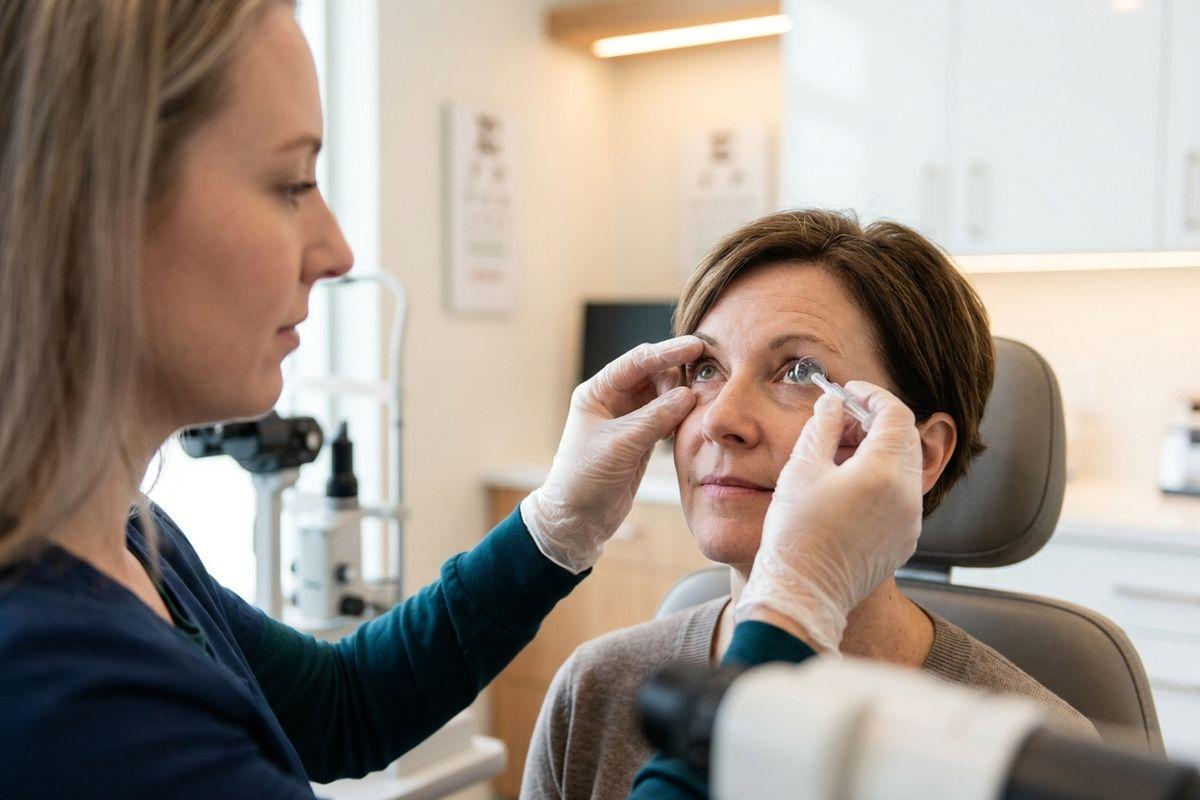
Treatment depends on how far the condition has progressed. Corneal collagen cross-linking is a procedure that can help stop progression of the condition by strengthening the corneal tissue. For cases that have advanced significantly, a corneal transplant may be considered. The earlier keratoconus is caught, the more options are on the table. Once the cornea is stabilized, specialty contact lenses are considered. Specialty contacts vault over the corneal surface, creating a smoother optical surface for light to pass through. There are many different types available and need to be customized to your shape, such as scleral or hybrid contact lenses, or combination systems.
Keratoconus vs Astigmatism: How to Tell Them Apart
On the surface, the two can feel very similar. Blurry vision, light sensitivity, and difficulty seeing at night are part of both conditions. This overlap is part of why keratoconus sometimes goes undetected for years.
Symptoms That Overlap
Both conditions can produce blurry and distorted vision. The difference is that keratoconus symptoms tend to worsen over time even with updated corrective lenses, while astigmatism stays relatively stable.
How a Diagnosis Gets Made
A standard vision test won’t catch keratoconus. Specific tools help make the distinction clear.
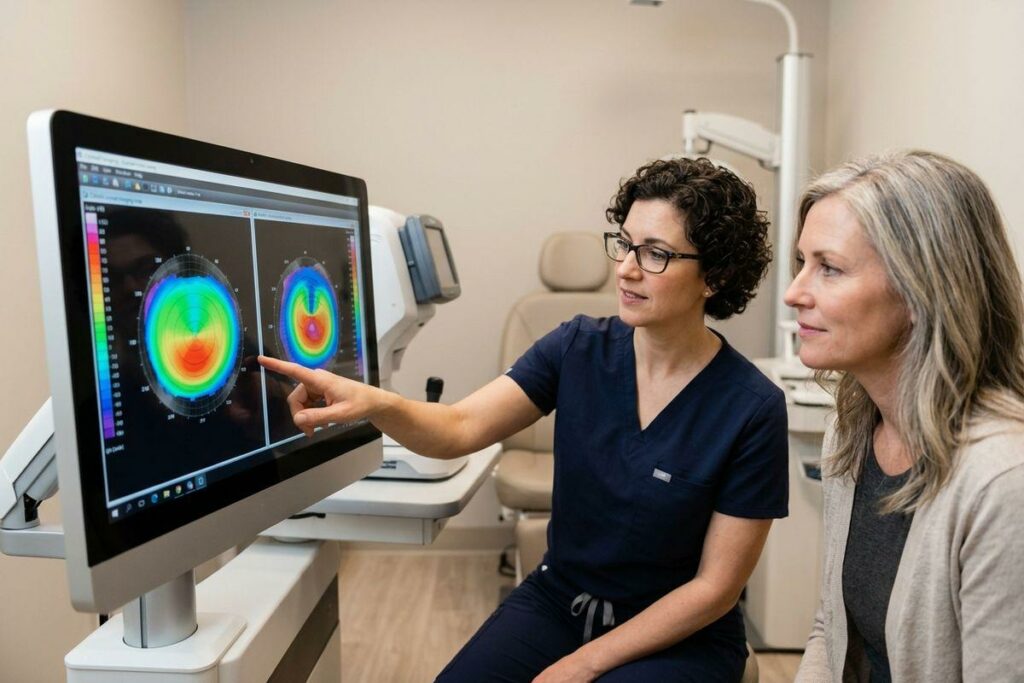
- Corneal tomography, such as the Pentacam test, maps the shape and curvature of your cornea, revealing irregularities that aren’t visible in a routine exam. This test is necessary, and the gold standard for diagnosis.
- Pachymetry measures the thickness of your corneal tissue, which can flag thinning before symptoms become obvious.
- Keratometry measures major shape changes of your cornea and, if noticed, a referral to a cornea specialist is necessary.
Together, these tools give your ophthalmologist, preferably a cornea specialist, a much clearer picture of what’s happening with your eyes.
Why an Early Eye Exam in Calgary Matters
If your vision keeps changing and your glasses or contacts don’t seem to be helping the way they should, it’s worth getting your eyes checked. Keratoconus caught in its early stages responds better to treatment and offers more options for managing the condition long-term. Left unaddressed, however, it can lead to significant and harder-to-manage vision loss.
Our team at Vector Eye Centre offers thorough diagnostic care and takes the time to walk you through exactly what’s going on with your eyes. Whether you’re dealing with a straightforward prescription concern or something that’s been harder to pin down, reaching out for a proper evaluation is the right first step.
Speak with your optometrist to determine whether a referral to Vector Eye Centre is required.