

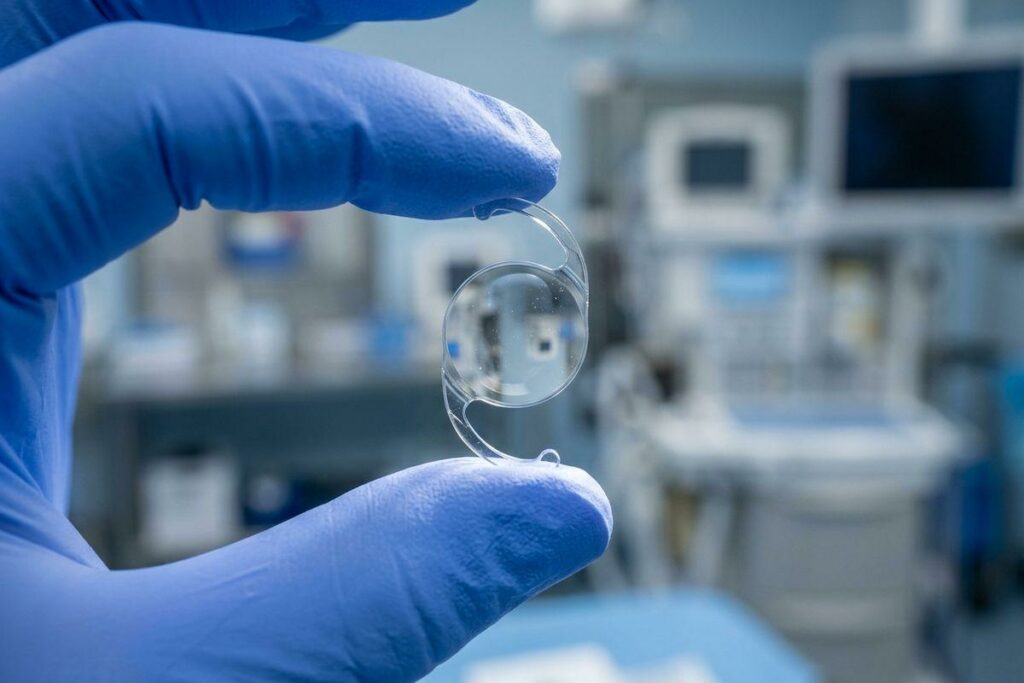
Cataract surgery replaces your eye’s cloudy natural lens with an artificial one. For years, whatever prescription you and your surgeon settled on before surgery was the one you were committed to afterward, and with a standard lens, that’s still the case.
A Light Adjustable Lens is a photo-sensitive implant that lets your surgeon fine-tune your prescription after surgery, once your eyes have had time to heal. It’s a different way to think about precision, one that accounts for how your eyes actually recover rather than relying solely on prior measurements.
How Does a Light Adjustable Lens Work?
A Light Adjustable Lens (LAL) is made from a special material that responds to UV light. When targeted UV light hits specific areas of the lens, the lens power changes right there. That means your prescription gets set after surgery, not before.
This matters more than it might seem. Every eye heals a little differently. Pre-surgery measurements are accurate, but they can’t predict exactly how your eye will respond to the implant. A LAL removes that uncertainty by letting the ophthalmologist adjust based on what your eye actually does during recovery.
What Happens During LAL Surgery and Adjustment?
The process happens in 2 parts: placing the lens, then fine-tuning it once your eyes settle.
The Implant Step
The surgical portion works just like standard cataract surgery. Your surgeon removes the cloudy natural lens and replaces it with a LAL. If you’ve already been told you need cataract surgery, the main difference here comes down to which lens goes in.
Adjusting Your Prescription
This is where the LAL stands apart. Once your eyes heal enough, you’ll come in for a series of UV light treatments. Each session takes about 90 seconds. Most people need 2-3 LAL adjustments, spaced from 3-7 days apart.
At each visit, your ophthalmologist checks how your vision is responding and adjusts the lens accordingly. Once the target prescription is reached, final (lock-in) UV treatments lock the lens in place. After that, no further changes can be made, so the locking step only happens when both you and your doctor are satisfied with the result.
Why Choose a Light Adjustable Lens?
Precision is the biggest draw here. Instead of locking in whatever your pre-surgery calculation predicted, your prescription gets shaped by how your eyes actually perform after healing. For anyone who’s worn glasses or contacts most of their life, that can feel like a real change.
A LAL gives you a few things a standard lens can’t:
- Get a prescription built around your real healing, not just pre-surgery estimates
- Reduce your reliance on glasses or contacts after surgery
- Access more precision than fixed-power lens options offer
- Adjust your results over multiple visits until they feel right
What to Know Before Choosing the LAL
During the adjustment phase, you will need to wear UV-blocking glasses during all your waking hours until your final locking treatment. This protects the lens from accidental UV exposure, like sunlight or certain indoor lighting, that could change your prescription before it’s set.
It’s a temporary commitment. Still, take it seriously.
Also, not every eye condition qualifies for a LAL. Your ophthalmologist will review your full eye health history before recommending it. The upfront cost runs higher than a standard intraocular lens, and the adjustment phase means a few extra follow-up visits. Currently, the LAL is the most accurate and precise intraocular lens offered worldwide as it can be adjusted after surgery.
If a customized visual outcome and less dependence on glasses long-term matter to you, weigh that against the added cost and time.
Who Is a Good Fit for a LAL?
A LAL tends to suit people who want greater control over the outcome of their cataract surgery. If you’ve been frustrated by glasses or contacts for years and are now facing surgery, this lens offers a real path to sharper vision.
Generally, a LAL is good for:
- Adults who want to reduce or remove their need for glasses after eye surgery
- People with cataracts who also carry an existing prescription for glasses or contacts
- Anyone who values precision and wants their vision tailored to how their eyes actually heal
- Patients who have undergone previous laser vision correction (PRK, LASIK, SMILE, RK)
- Patients with limited dry eye or controlled ocular surface inflammation
If you’re over 45, considering refractive lens exchange, and want a prescription that’s shaped by your real healing process, a LAL is worth a conversation. Whether you’re weighing refractive lens exchange or wondering how your eyes might heal, bring those questions to your ophthalmologist before you decide.
Ready for a Clearer Picture?
A LAL won’t suit everyone, but for the right candidate, it offers a level of control most standard lenses can’t match. When you meet with us for a consultation at Vector Eye Centre, you can talk it through with someone who works with this technology regularly and get a straight answer about whether it fits your eyes and your lifestyle.
Book a consultation with our team and find out whether a Light Adjustable Lens is the right next step for your vision.