


Nearsightedness, or myopia, can make it difficult to perform simple tasks like reading road signs or recognizing a face across the room. If you’re tired of reaching for glasses or dealing with contact lenses, you’ve likely considered a more lasting solution. At Vector Eye Centre, you can explore several refractive eye surgery options designed to help you correct your distance vision for the long term.
For many people, the answer is yes. Laser eye surgery procedures like PRK and implantable collamer lens (ICL) surgery are designed to correct myopia. These options can permanently reshape your eye’s surface or supplement its natural lens, allowing light to focus properly and reducing your need for corrective lenses.
A Look at Your Vision Correction Options
When it comes to permanent vision correction, you have options beyond a single type of procedure. Both PRK and ICL are highly effective methods to address myopia, but they work in different ways to help you achieve clearer distance vision.
How PRK Corrects Your Focus
PRK (photorefractive keratectomy), is a type of laser eye surgery. It corrects your focus by gently reshaping the surface of your cornea, the clear, dome-shaped front part of your eye. A cool-beam laser adjusts the curvature so that light lands correctly on your retina, which sharpens your view of distant objects.
How ICL Corrects Your Focus
ICL surgery works differently. Instead of reshaping your cornea, it involves placing a thin, biocompatible lens inside your eye. This lens sits behind your iris and in front of your natural lens, working with your eye’s existing structures to focus light accurately. It’s an additive solution that doesn’t remove any corneal tissue.
Who Is a Good Candidate?
A suitable candidate for vision correction typically has a stable prescription and good overall eye health. Your age, corneal thickness, and prescription strength all play a part in determining which procedure is a good fit. A complete assessment is the only way to know for sure.
Suitability for PRK
PRK can be an excellent choice if you have thinner corneas, which might make you less suitable for other laser procedures. Because it avoids creating a corneal flap, it’s also often recommended for people with very active lifestyles or those in professions with a higher risk of eye impact.
Suitability for ICL
ICL is often a great option for people with very high levels of myopia that may be outside the range for laser correction. It’s also a valuable alternative if you experience significant dry eye, as the procedure does not typically worsen symptoms of dry eye, something many Calgary residents may face.
The Limits of Vision Correction Surgery
While modern vision correction is effective for many people with myopia, no single procedure is right for everyone. The best option for you depends on your unique prescription and eye structure. These factors are evaluated carefully to help you make an informed choice.
Your Prescription Strength Matters
PRK is very effective for mild to moderate myopia. If your prescription is very high, ICL surgery may be a more suitable choice. The implantable lens is designed to correct a wide range of prescriptions, including severe nearsightedness, with precision.
Cornea Health & Thickness
Your cornea’s health is a key factor. A detailed map of the corneal surface, created using a test like corneal tomography, helps determine suitability. PRK works directly on the surface, making it a sound option for those with thinner corneas. Since ICL surgery doesn’t alter your cornea at all, it can be an ideal solution when corneal health or thickness is a concern.
What to Expect During & After the Procedures
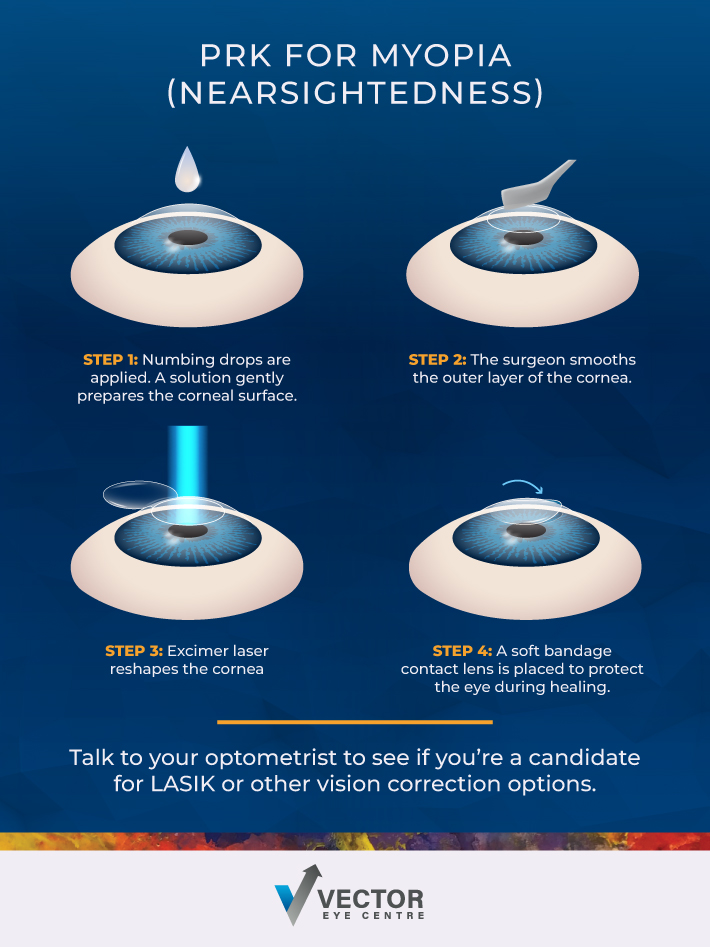
Knowing what happens during the surgery and recovery can help you feel more comfortable and prepared. The processes for PRK and ICL are different, but both are well-established surgical methods designed for your safety and comfort.
The PRK Procedure & Recovery
During PRK, numbing drops are used to keep you comfortable. The thin, outer layer of the cornea is gently removed, and a laser is used to reshape the tissue underneath. A protective, soft contact lens is then placed on your eye to help it heal. Your vision will be blurry at first but should improve steadily over the next several days and weeks.
The ICL Procedure & Recovery
The ICL procedure is also done with numbing drops. The surgeon makes a tiny opening to insert the flexible, soft lens into your eye. The lens unfolds into position and starts working right away. Many people report clearer vision almost immediately, and recovery is often very quick.
The Value of a Consultation for Eye Surgery Calgary
The only way to know which vision correction option is right for you is through a thorough eye assessment. A consultation will evaluate your vision goals and unique eye health. This helps create a personalized treatment plan that fits your life and your needs.
PRK and ICL are just two of several options available today to help you see more clearly. At Vector Eye Centre, the team is here to walk you through all the possibilities and answer your questions. Contact the team to explore the best path forward for your vision.